

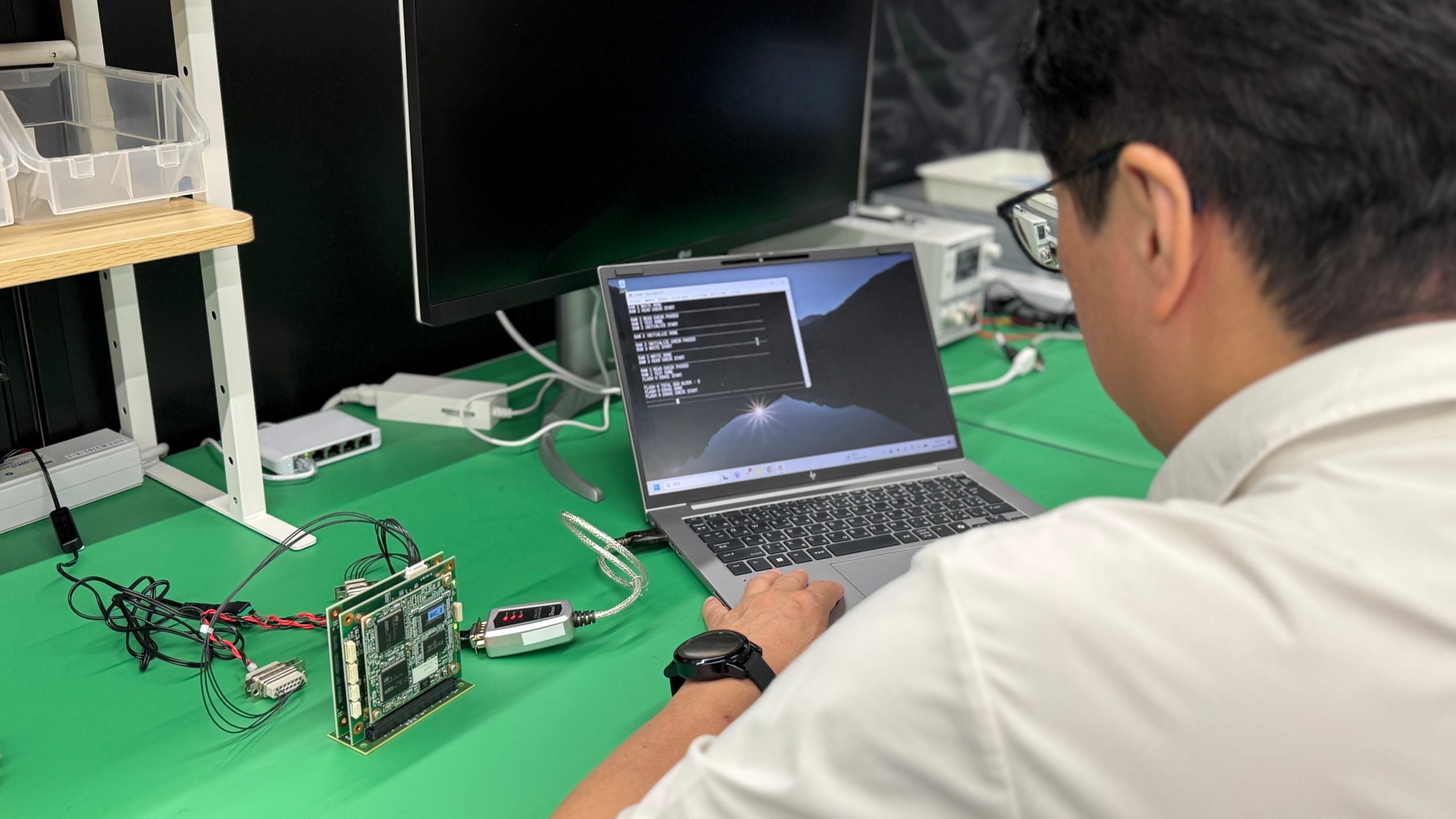
Tokyo, Japan, September 7, 2026 – ArkEdge Space Inc. (“ArkEdge Space”), a Tokyo-based space start-up delivering micro-satellite constellations from design to operations, today announced the successful in-orbit demonstration of its proprietary onboard computer (OBC) aboard the AE2a small satellite, launched on June 24, 2025. The demonstration achieved all predefined success criteria.
Since its June 2025 launch, the OBC has operated stably in orbit while ArkEdge Space quantitatively evaluated its performance in the space radiation environment. No impact on satellite operations attributable to radiation effects has been observed. ArkEdge Space also successfully updated the OBC’s entire flight software after launch via ground uplink and confirmed normal operation following the update.
The demonstration validates a new OBC architecture developed in-house to address challenges ArkEdge Space encountered through the development and operation of multiple small satellite missions. The OBC has now been adopted as the main onboard computer for ArkEdge Space’s general-purpose 6U satellite bus and is being incorporated into multiple upcoming satellites and projects.
Next-Generation OBC Built from Satellite Development Experience
The onboard computer serves as a satellite’s central computing system, controlling onboard equipment, processing commands from the ground, and managing telemetry and other spacecraft data.
As ArkEdge Space continued to develop and operate multiple types of satellites, it identified challenges with its existing OBCs, particularly long-term component availability and evolving performance requirements. To address these challenges, the company developed an OBC tailored to its own satellite development needs.
Rather than relying on expensive, difficult-to-source space-grade components, the OBC uses automotive-grade components with established quality standards and reliable supply chains. This approach improves component availability while reducing manufacturing costs.
ArkEdge Space developed new hardware and a software abstraction layer while retaining flight-proven applications and communication protocols from its existing satellite systems. This architecture enables the company to leverage existing designs, verification results, and operational experience while transitioning smoothly to the new OBC.
In-Orbit Demonstration Validates Stable Operation
The OBC was installed aboard AE2a as a demonstration payload independent of the satellite’s primary mission. In orbit, ArkEdge Space evaluated startup and communications, memory systems, external interfaces, thermal performance, operation in the space radiation environment, and flight software updates.
Throughout the demonstration period, no anomalous resets attributable to the OBC occurred. The OBC’s internal SRAM was checked at approximately 36-minute intervals. No uncorrectable errors were observed, and all detected memory errors were within the correction capability of the error-correcting code (ECC). None affected satellite operations.
Continuous temperature monitoring also confirmed that heat generation caused no operational issues. Together, these results demonstrate the OBC’s stable operation in the space radiation environment and support the effectiveness of the radiation-mitigation measures incorporated into its design.
Full Flight Software Successfully Updated After Launch
As part of the demonstration, ArkEdge Space successfully updated the OBC’s entire flight software via ground uplink. The OBC subsequently booted with the updated software, and normal operation of its functions was confirmed.
The OBC uses a dual-bank architecture with two separate storage areas for flight software. During an update, new software is written to the inactive bank and verified before operations are switched to the updated bank, reducing the risk associated with in-orbit software updates.
Because small satellites have limited uplink capacity, a complete software image may need to be transmitted over multiple ground contacts. For this demonstration, ArkEdge Space divided the software upload across multiple contacts while continuing to operate with the existing software throughout the process.
In-orbit reprogrammability enables new functionality to be added and software issues to be addressed after launch. It also allows new capabilities to be tested in the space environment, with the results rapidly incorporated into subsequent satellite development.
From In-House Engineering to In-Orbit Validation
The new OBC originated from technical challenges identified by ArkEdge Space engineers through hands-on satellite development. Rather than limiting the project to ground-based prototyping and testing, the company created an opportunity to validate the technology in orbit aboard AE2a through over a year of in-orbit operation.
For the demonstration, the OBC was flown as an “internal hosted payload” independent of AE2a’s primary mission, allowing ArkEdge Space to build flight heritage for the new OBC while minimizing the impact on the satellite’s development and operations.
The project demonstrates ArkEdge Space’s ability to identify engineering needs internally, develop the required technology, validate it aboard its own satellites, and feed the results directly into subsequent satellite development. It also reflects the company’s engineering culture, in which engineers can propose solutions to challenges encountered in satellite development and carry them through to validation in the space environment.
Looking Ahead
The OBC has been adopted as the main OBC for ArkEdge Space’s general-purpose 6U satellite bus and is being incorporated into multiple satellites and projects currently under development. ArkEdge Space also plans to apply the technology to other onboard computing systems, including those for attitude and orbit control.
The company will continue evaluating data collected in orbit to further update the software and enhance the OBC’s capabilities. By maintaining an integrated development cycle—from concept and development through in-orbit demonstration and application to next-generation satellites—ArkEdge Space aims to accelerate the development, serial production, and operation of small satellites.
The AE2a satellite bus was developed under a project initially selected for support by Japan’s Ministry of Economy, Trade and Industry (METI) in FY2021 and subsequently supported by the New Energy and Industrial Technology Development Organization (NEDO) from FY2023 onward. The project supports the development and demonstration of a standardized 6U general-purpose satellite bus, together with production and operations systems designed to enable the rapid and efficient production of multiple satellite types.
About ArkEdge Space
ArkEdge Space is a Japanese space technology company offering end-to-end solutions for micro-satellite constellations—from planning and design to mass production and operations. Guided by its mission of “empowering people with satellites for a prosperous future,” the company is advancing capabilities in Earth observation, maritime satellite communications (VDES), optical communications, and low-Earth orbit satellite positioning, as well as lunar activities and deep space exploration. Through our mission, ArkEdge Space continues to drive the advancement of space innovation and its practical application.
Head Office Location
3F, Dome Ariake Headquarter, 1-3-33 Ariake, Koto-ku, Tokyo, Japan
CEO: Takayoshi FUKUYO
Founded: in July 2018
Website: https://arkedgespace.com/