

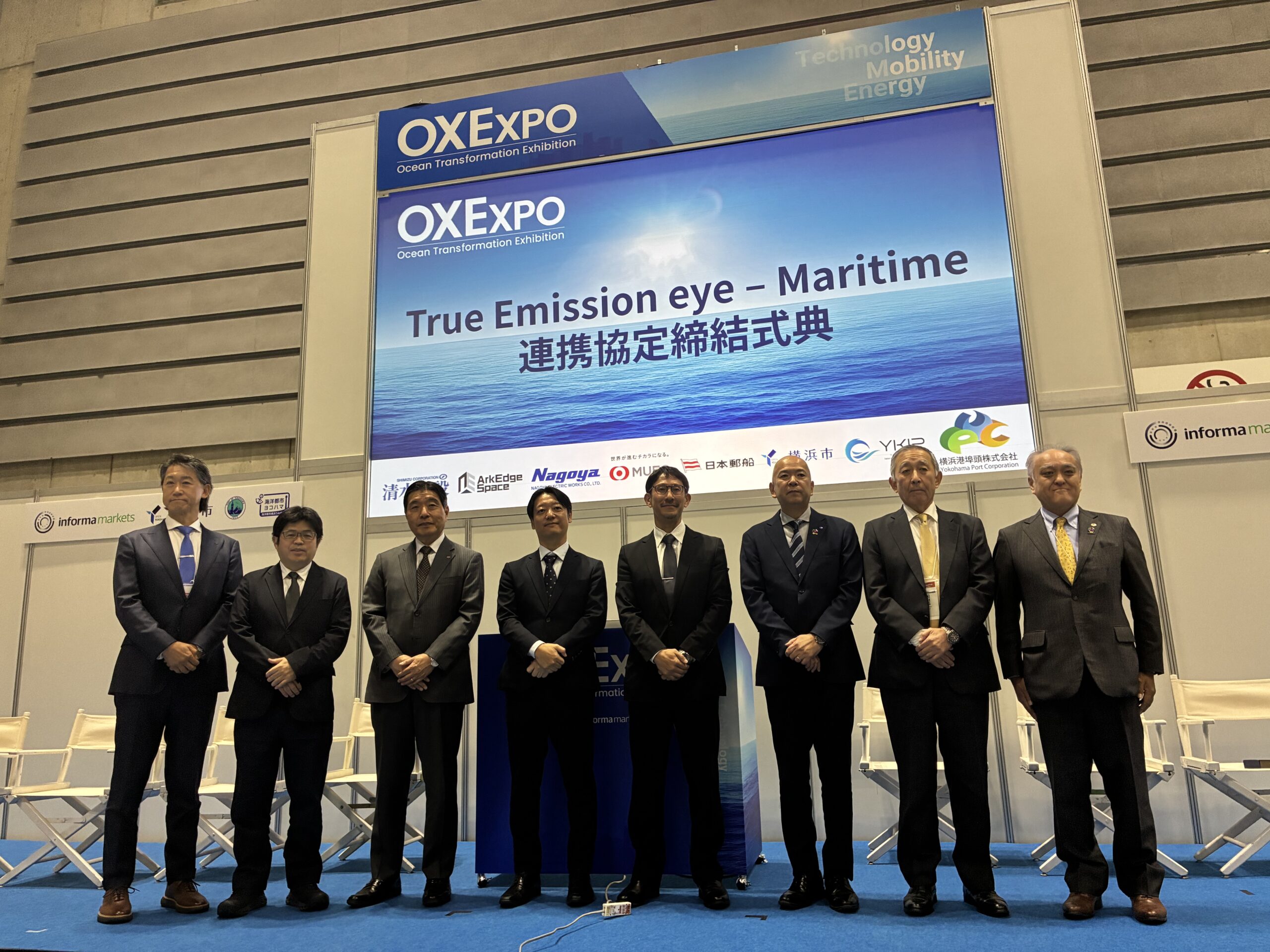
Tokyo, Japan, November 25, 2026 – Nippon Yusen Kabushiki Kaisha, MUFG Bank, Ltd., Nagoya Electric Works Co., Ltd., ArkEdge Space Inc., Shimizu Corporation, City of Yokohama, Yokohama-Kawasaki International Port Corporation, and Yokohama Port Corporation signed a collaboration agreement on November 25 to develop remote sensing technology for measuring greenhouse gas (GHG) emissions from ships at a distance and bringing it into practical use.
Under the agreement, the eight organizations will advance “True Emission Eye – Maritime,” a project to measure, visualize, and quantify GHG emissions from ships without physical contact. At Yokohama Port as the primary demonstration site, the project will conduct measurements on actual vessels and assess the accuracy of the technology. The project will also examine the specifications of the measurement and analysis system, potential applications, and opportunities for future business deployment.
Background
Technologies for objectively assessing GHG emissions from ships are becoming increasingly important as the international shipping industry continues its efforts to reduce emissions.
GHG emissions from ships are primarily estimated based on fuel type and consumption. To complement these estimates, the organizations focus on remote sensing technology that enables direct measurement of GHG emissions from ships at a distance.
The practical application of remote sensing technology has the potential to measure GHG emissions from outside vessels and improve the objectivity and accuracy of emissions assessments. Future wide-area observations using drones, satellites, and other platforms are also expected to help objectively visualize the decarbonization progress of individual vessels and contribute to a more transparent and fair market.
Overview of “True Emission Eye – Maritime”
The project focuses on developing technology to visualize and quantify GHG emissions by leveraging the ability of gases, including carbon dioxide, to absorb and emit light at specific wavelengths. The approach combines ship exhaust data obtained using optical observation technology with relevant physical parameters, such as the distance to the vessel and weather conditions, to calculate emissions.
The project has conducted tests at experimental facilities and measurements on Nippon Yusen Group vessels, both at berth and underway. At Yokohama Port, the project has captured infrared images of ship exhaust from locations including Osanbashi Pier and the Yokohama Bay Bridge Skywalk, and is comparing and analyzing these images with vessel data.
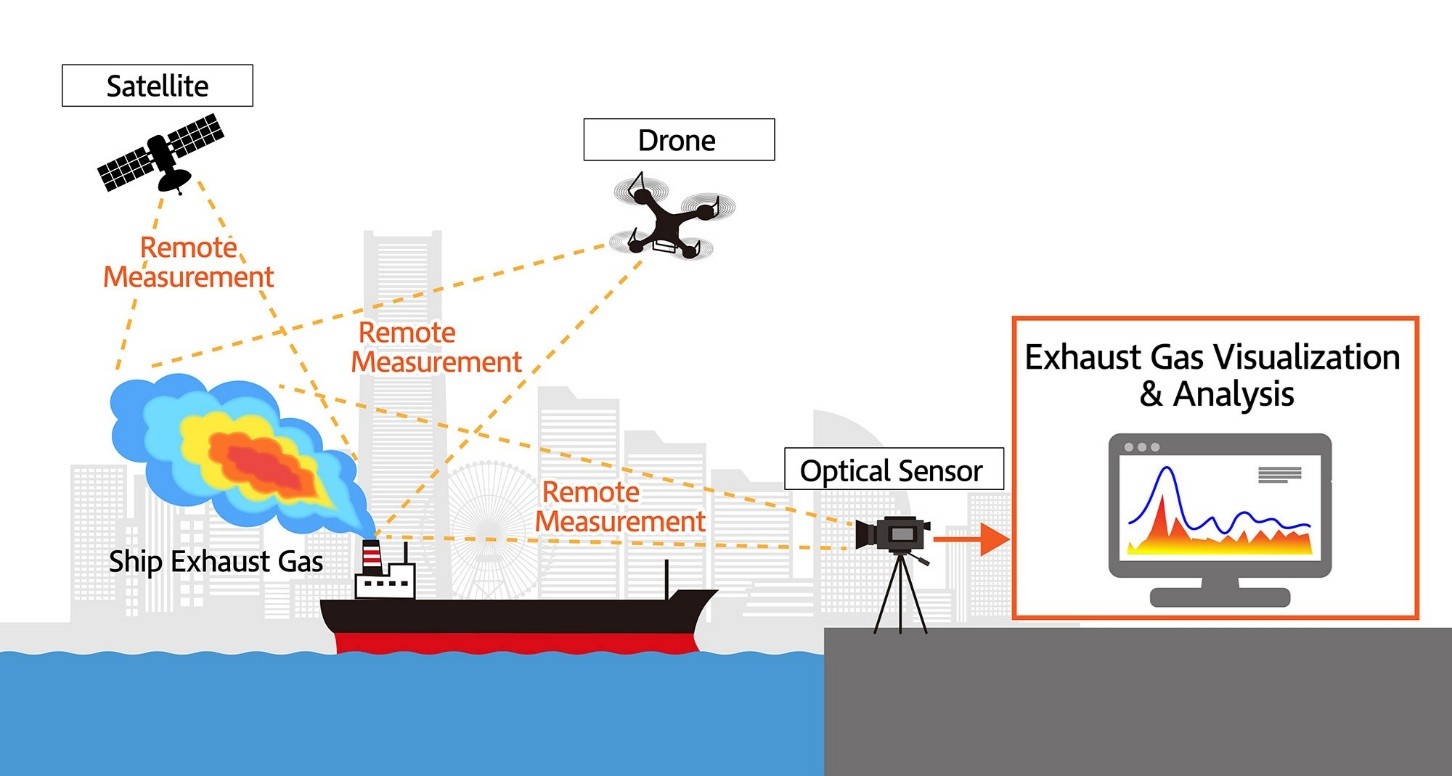 Conceptual image of the system
Looking Ahead
The project will continue conducting measurements on actual vessels, primarily at Yokohama Port, to improve the accuracy of its measurement and analysis technology through testing under various conditions and comparisons with vessel data.
The project will also examine observation methods, including fixed-point monitoring at ports, and assess the technical requirements for observing GHG emissions from ships using satellites. The project will also explore the potential integration of satellite observations with ground-based data.
Through continued collaboration, the eight organizations aim to bring the technology into practical use to help improve transparency in GHG emissions from ships and support decarbonization in the shipping and port sectors.
[1] Nippon Yusen Kabushiki Kaisha (NYK Line)
Founded in 1885, Nippon Yusen Kabushiki Kaisha is a global logistics company that focuses on various forms of marine transportation, such as global logistics and bulk energy transportation, among many other related businesses. Operating one of the world’s largest transportation networks, the company owns and operates a diverse fleet of car carriers, container carriers, and energy carriers. In recent years, Nippon Yusen Kabushiki Kaisha has actively entered new business areas, including the decarbonization business, by leveraging the knowledge and technology we have cultivated over many decades in shipping.
[2] MUFG Bank, Ltd.
MUFG Bank, Ltd. is a consolidated subsidiary of Mitsubishi UFJ Financial Group, Inc. (MUFG). Under its corporate philosophy, the “MUFG Way,” MUFG has established “Committed to empowering a brighter future” as its corporate purpose. The group works to address challenges faced by its customers and other stakeholders while contributing to a sustainable environment and society. MUFG Bank aims to contribute to this initiative by leveraging its extensive network and expertise in decarbonization.
[3] Nagoya Electric Works Co., Ltd.
Founded in 1946, Nagoya Electric Works Co., Ltd. develops, manufactures, and sells equipment and systems that support road traffic safety, including variable message signs, temporary traffic signs, and disaster prevention and mitigation systems. Through these activities, the company has contributed to creating a safer society for decades. Nagoya Electric Works is also applying its image analysis technologies to the environmental sector, pursuing new technological developments, including GHG emissions visualization.
[4] ArkEdge Space Inc.
ArkEdge Space Inc. is a space startup specializing in the design, manufacturing, launch, and operation of small satellites. The company develops a wide range of satellite missions and space-based services to address societal challenges in areas including Earth observation, maritime applications, satellite communications, positioning and navigation, and deep space exploration.
[5] Shimizu Corporation
Founded in 1804, Shimizu Corporation upholds a legacy of sincere craftsmanship and an enterprising spirit. With construction (building, civil engineering, and overseas) as its core, the company operates across diverse fields, including real estate, engineering, green energy, building life cycles, and frontier businesses. Positioning space as the industry’s “frontier,” Shimizu advances transportation operations like small rocket launch support, GNSS satellite data utilization, and lunar development research.
[6] City of Yokohama Port and Harbor Bureau
The Port and Harbor Bureau of the City of Yokohama is working to establish a carbon neutral port with the aim of achieving a decarbonized society by 2050. Under the “Port and Harbor Decarbonization Plan for the Port of Yokohama,” the City of Yokohama is collaborating with public and private sector partners to promote the adoption of next-generation marine fuels and advancing the development of onshore power supply facilities. It is also working to accurately quantify greenhouse gas (GHG) emissions from ships operating within Yokohama Port.
[7] Yokohama-Kawasaki International Port Corporation
Yokohama-Kawasaki International Port Corporation promotes Japan’s International Container Strategic Port Policy at the ports of Yokohama and Kawasaki. Through this initiative, the company aims to enhance the international competitiveness of both ports and achieve sustainable port operations by improving the accuracy and visualization of greenhouse gas (GHG) emissions from ships, advancing the use of environmental data in the port sector, and creating new environmental value.
[8] Yokohama Port Corporation
Yokohama Port Corporation develops, leases and manages logistics facilities at Yokohama Port to support the smooth flow of cargo. Working with a wide range of stakeholders, the company promotes green supply chains and strengthens resilience to create a sustainable port that serves both people and the environment. Drawing on its extensive experience and expertise in port operations, it also provides consulting services to ports in Japan and around the world.