

Tokyo, Japan, March 10, 2026 – ArkEdge Space Inc. (“ArkEdge Space”), a Tokyo-based space start-up delivering micro-satellite constellations from design to operations, today announced that its project in the Kyrgyz Republic has been selected under Japan’s Ministry of Economy, Trade and Industry (METI) FY2024 Supplementary “Global South Future-Oriented Co-Creation” Subsidy Program[2] (Small-Scale Demonstration / Feasibility Study category).
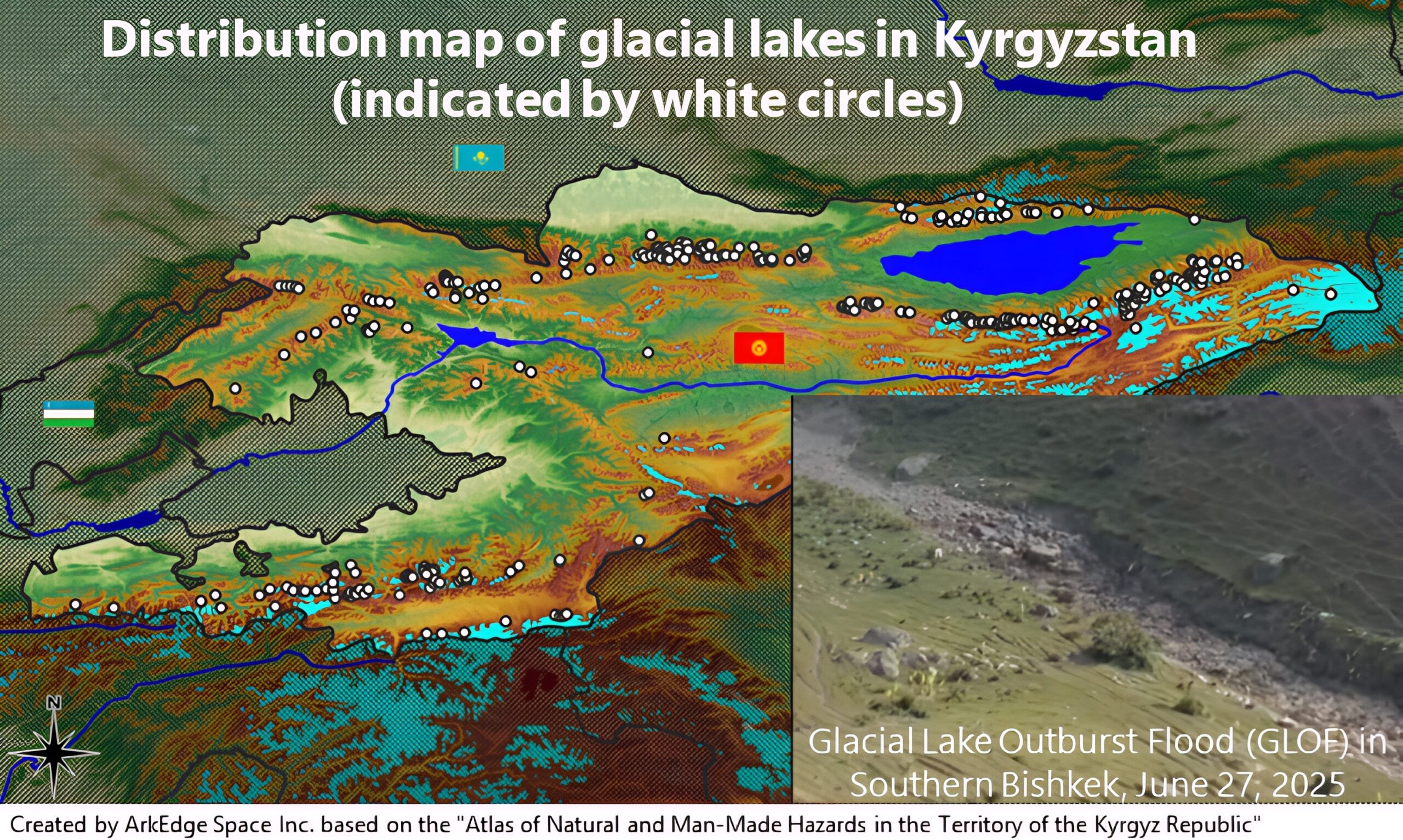
The project will evaluate the deployment of satellite-based monitoring technologies to address the increasing frequency of glacial lake outburst floods (GLOFs) and landslides driven by climate change, while also contributing to the preservation of the country’s abundant water resources. The initiative focuses on satellite imagery analytics and satellite IoT as core enabling technologies.
Under the program, ArkEdge Space will conduct a comprehensive feasibility study (FS) assessing the technical, regulatory, and economic viability of implementing these systems and evaluating their potential for long-term operational deployment and commercialization.
Project Background
More than 90% of Kyrgyzstan’s territory lies above 1,500 meters in elevation. In recent years, climate change has accelerated natural disasters such as glacial lake outburst floods (GLOFs) and landslides. At the same time, sparse communication and observation infrastructure in many regions presents significant challenges in establishing wide-area, continuous monitoring. This project seeks to bypass these constraints by leveraging satellite-enabled infrastructure to strengthen disaster resilience and water resource management.
Scope of the Feasibility Study
The project will conduct a multi-dimensional feasibility study (FS) covering technical, regulatory, and economic dimensions, economic viability of introducing these monitoring systems, focusing on the following areas:
Glacial Lake Outburst Flood (GLOF) Monitoring
In collaboration with the Ministry of Emergency Situations of the Kyrgyz Republic, and the University of Central Asia, the project will audit the accuracy and operational constraints of existing systems. The study will assess the effectiveness of fusing multi-source satellite data with high-cadence [1] LoRa-based IoT sensors, and evaluate spectrum requirements, maintenance frameworks, and potential market size.
Landslide Monitoring
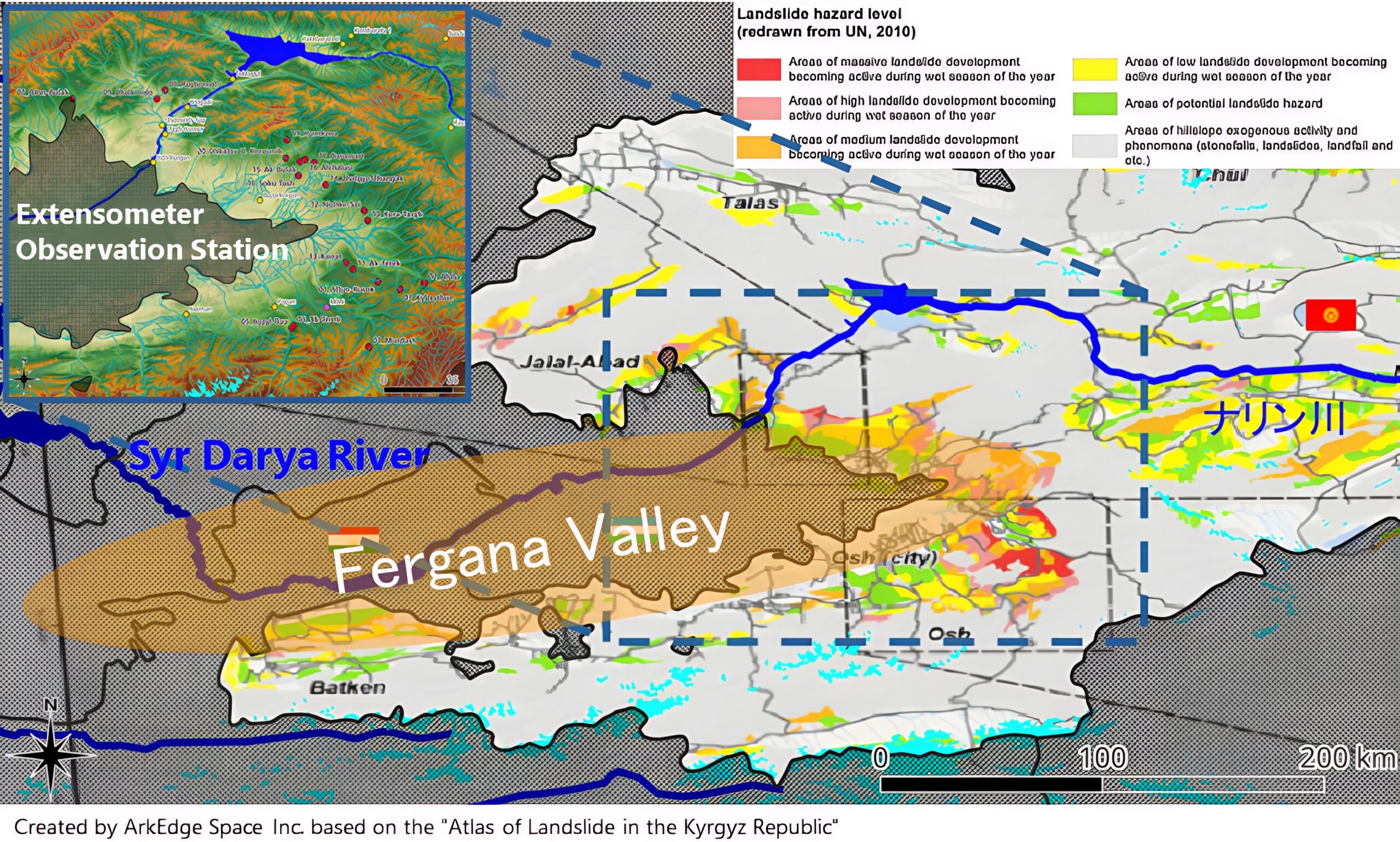
In cooperation with the National Academy of Science of Kyrgyz Republic, the project will examine landslide risks in the Fergana Valley and environmental hazards at former mining sites. The study will evaluate opportunities for digital transformation (DX) by integrating satellite analytics with IoT, ensuring interoperability with existing ground-based systems and defining commercialization frameworks.
Water Quality Monitoring Around Aquaculture Sites
In cooperation with the Ministry of Water Resources, Agriculture and Processing Industry of the Kyrgyz Republic, the project will address the growing demand for enhanced monitoring amid the rapid expansion of the aquaculture sector. The study will assess the operational integration of satellite-derived data
(surface color, turbidity, surface water temperature, and water level changes) with on-site IoT sensors (water temperature, pH, etc.). It will also evaluate the customization of ArkEdge Insights® and explore business models for both government procurement and private-sector use.
Ground Station Construction Feasibility
In continued dialogue with the Ministry of Digital Development, the project will assess the requirements for a future ground station including technicality, candidate site conditions, spectrum environment, legal and regulatory pathways, procurement considerations, and operational frameworks to ensure long-term viability.
The study is scheduled to run from April 2026 through February 2027. Activities will include:
- Detailed audit of existing monitoring systems
- Field assessment for IoT deployment
- Design requirements for satellite IoT sensors (including [2] EU868 compliance)
- Integration analysis with existing systems
- Commercial viability assessment of proposed services
- Assessment of horizontal expansion to other mountainous regions
Based on the findings, ArkEdge Space will outline a practical roadmap toward full-scale demonstration and commercialization.
Through this initiative, ArkEdge Space seeks to establish a global model for solving communication and environmental challenges unique to mountainous countries. The project is also intended to drive the expansion of integrated space and digital transformation solutions across Central Asia and a potential application in other climate-vulnerable regions worldwide.
[1] LoRa: Low-power, long-range wireless communication protocol suitable for remote IoT sensor networks.
[2] EU868: European 868 MHz frequency band commonly used for LoRa communications.
About ArkEdge Space
ArkEdge Space is a Japanese space technology company offering end-to-end solutions for micro-satellite constellations—from planning and design to mass production and operations. Guided by its mission of “empowering people with satellites for a prosperous future,” the company is advancing capabilities in Earth observation, maritime satellite communications (VDES), optical communications, and low-Earth orbit satellite positioning, as well as lunar activities and deep space exploration. Through our mission, ArkEdge Space continues to drive the advancement of space innovation and its practical application.
Head Office Location
3F, Dome Ariake Headquarter, 1-3-33 Ariake, Koto-ku, Tokyo, Japan
CEO: Takayoshi FUKUYO
Founded: in July 2018
Website: https://arkedgespace.com/